Monday, December 12, 2011

BE CORRECT!

I have been saving the best for last. This is probably my biggest pet peeve from Facebook.


Most internet browsers have spell check. Don't ignore those little red lines. Take their advice and double check your spelling. Double check the use of "it's" and "its" if you need to because there will be people out there (me) who will make fun of your poor spelling and grammar or just roll my eyes at your whining because you couldn't figure out how to form a complete, correct sentence. I realize we all make mistakes sometimes (I make several a day), but there are little things that can really make an impression on people. And no, Facebook isn't an English class, but why not just do it correctly and save yourself from looking stupid? Seems easy enough to me.

A few things to make sure you always do:
  1. Capitalize names of people, the beginning of sentences, and other formal nouns.
  2. Punctuate.
  3. Check your spelling. Don't ignore those red lines....
Bonus points!
  1. Check your use of pesky homonyms. (Words that sounds the same, but are spelled differently and have very different meanings.
    • Common errors: it's/its, their/they're/there, we're/were, here/hear, effect/affect, etc. (I still look some of these up from time to time... They can be tricky!)
Anything you write informally will find its way into your more formal prose such as school papers, e-mails to your boss, or job applications. Practice correctness at all times and you will get better. You're already online - just search for the correct use. It might take an extra sixty seconds, but you just might learn something that you can apply the next time. Use Facebook as opportunity to practice correct prose and show off your skills as a correct writer. (Warning: Do not become the person who always corrects people, especially if you aren't sure yourself. You might look silly when you "correct" something that was already right.

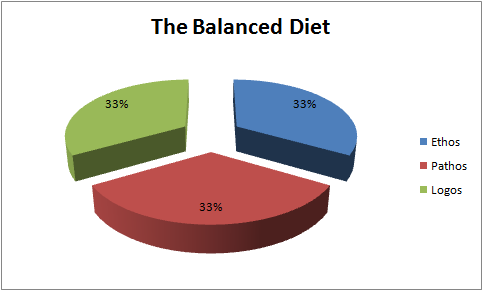
Ethos, Pathos, and Logos (or Greek words I usually mess up)

So what are logos, pathos, and ethos? Good question...

http://ow.ly/7XelI
Ethos is a writer's credibility. Think about it in terms of the Big Bad Wolf. If you cry false wolf too many times, no one will believe you any more. It's the same thing if you post "TODAY WAS THE WORST DAY EVER!" every other day on Facebook. No one will believe you, people will quit giving you real sympathy, and just start to brush it off. (Or hide you from their main activity feed - that's what I do!)

Pathos is appealing to the readers' emotions. Make your Facebook friends laugh - amuse them, tease them, make them smile. Heck, every once in awhile tell them a story that will make them cry (just refer to ethos first). But most importantly, be sensitive to their emotions. Don't bully your Facebook friends (or they won't be your friends for long) or use Facebook (what should be a community of friends) to belittle or attack certain groups.

Logos is using reason. Usually it is attached to persuasion but in relation to Facebook, I'm going to call it common sense. Use the head upon your shoulders and think before you post. How will this post make others feel, what is the point in making it? Will you hurt anyone's feelings? Are you willing to deal with the consequences? If you can accept any repercussions that could come from posting it, go for it! Post it! And smile while you do it. Smiling just makes everything better.

(Information found here.)

Sunday, December 11, 2011

Concision

The general rule in most things is "more is less" and that certainly applies to Facebook. It's not like Twitter, you have as many characters as you possibly want (I think). However, do you want to read a novella on someone's wall? I certainly don't. The important thing is to keep things short as often as possible. Of course, this isn't an "always" rule, sometimes you just need to post a little more when something especially awesome is happening. Of course, don't ramble on forever. Here are some tips for keeping things as short as possible. (List and examples from Colomb & Williams' Style)

  1. Delete meaningless words - These are words that don't add meaning to your post but instead get in the way. These can include: kind of, actually, basically, generally, given, various, certain. However, Facebook is more informal than traditional discourse and more conversational in nature, but when writing a long status, think about omitting them.
  2. Delete doubled words - By removing any words that repeat meaning like "full and complete" or "any and all" you can apply some much needed concision to your statuses.
  3. Delete what readers can infer - This includes redundancy and just annoying repetition like "terrible tragedy" (that is why it's called a tragedy, right?), "future plans," "true facts," "final outcome," and "basic fundamentals."
  4. Change negatives to affirmatives - By expressing ideas in the negative, you often are adding words but are also asking the reader to interpret what you mean. Most negatives can be rewritten such as "not careful" becomes "careless" or "not include" can become "omit" or "remove."
Bonus points! (Do these and be extra spiffy!)
  1. Replace a phrase with a word - This requires a rather large vocabulary in order to do this, but if you can, go for it! Examples include changing "carefully read what you have written" to "edit" or "sequences of subjects and verbs" to "clauses." (Okay, that wasn't so bad...) 
  2. Delete adjectives and adverbs - This is hard to do in a more conversational or informal tone because they all feel SO necessary, but try taking them out and see how quickly your prose streamlines!

Saturday, December 10, 2011

Coherence? (Be clear, people.)

The number one priority of every writer - whether it's for English class, Facebook, or a text message - is to communicate something to the reader (or receiver). You can also think of this receiver as your audience. They should be your number one priority, right? You're trying to tell them something. So what if they can't understand it? Well, you've probably failed in your mission, haven't you?

If status updates are a glimpse into your life for those people who you don't see on a daily basis, then it doesn't do anyone (them or you) any good if they don't receive the message. A quick Google search reveals dozens of Facebook groups dedicated to bemoaning those statuses that make little to no sense.

Actually, this blog provides some hilarious things that we've all seen and found annoying. I could go on and on about how much these annoy me, but I won't. I'll simply link you and let you decide.

Basically, just say what you mean. Make it as easy for your readers to understand as possible. This is Facebook, not the next great American novel.

Characters

These are some famous characters:


http://ow.ly/7X4bH
http://ow.ly/7X40o


While you might be writing Facebook updates about these characters, chances are your updates will feature a few characters a bit closer to home like your sister, brother, roommate, boyfriend/girlfriend, mother, father, dog, cat, mailman, neighbor, or some random person you ran into at Hy-Vee. Yes, these are people but they can be characters just like cartoons. Isn't it TBS that says "Characters Welcome"? Well, the are certainly welcome in your writing and are practically required if you ever want anyone to know what you're talking about.

However, aside from the random gripe post, it's best to make sure your posts are in active voice or that the character is performing the action of your status update. It's also best if these characters can be flesh and blood, or real people. (Or animals... we all like posting about our pets. After all, more cats live on the internet than anywhere else!) When making status updates, you'll likely find it's very easy to write about flesh and blood characters because you'll be surrounded by them. This can often be more difficult in other types of writing, but I think you'll find it easy for this!

For example:

This is a pretty good status written in active voice. It's direct and to the point while maintaining a tone of happiness. Not everything you report on Facebook should be happy, but too many negative statuses and you just might find your friend count declining. No one really likes to surround themselves with negativity. 

This status much better than the more passive and less exciting:


(And no, an exclamation point does not convey excitement by itself.) Active voice is often more conversational while passive sounds a bit like Yoda (and sometimes just seems weird). 

Also, when reporting your status, tag your friends! Everyone likes the shout out! (@theirname - just like Twitter. See future posts for more information on Twitter!)


Friday, December 9, 2011

Kairos

So thanks to Ryan Gosling at the amazing people over at Rhet/Comp Ryan Gosling, I will never again forget what kairos is. You shouldn't either. You can thank me (well them) now.


Kairos is saying the right thing at the right time. For Facebook, this can mean a number of things. For example, it is considered rude to attack political views and groups of people on the internet, but people still do it. It is considered bad taste to leave inappropriate comments on friends' posts or to post photos of them they may not want their boss to see. 

Everything you post on Facebook is pretty much visible to anyone - especially your friends or friends of friends. (Unless you have your privacy settings set up very carefully, which I've sort of given up on as it's like trying to navigate a minefield to find any of the settings I'm actually looking for.) More and more, employers are looking at a potential employees Facebook or even regularly checking up on their employees. HR has become more and more important in this world and no company will "turn the other cheek" if an employee is publicly complaining about their company in this style of digital environment which can serve as a permanent record. 

Therefore, the following are "kairos" guidlines:
  1. Keep some things private - While kairos is saying the right thing at the right time, there might not EVER be an appropriate time to tell all 893 of your Facebook friends that you are "dilated to a 3 and can't wait to go into labor." Pregnancy used to be private and something that no one spoke of, while it's not quite that under wraps now (I'm glad), that doesn't mean we all need to know every little graphic detail of each step. Share that information with close friends or relatives by using the message feature. They are private and can keep uncomfortable things away from the eyes of others. Besides, what if your eight year old cousin sees that? Wouldn't you just LOVE to be his mother and have to explain that to him?
  2. Be professional - I feel like this might come up under every point, but as college students shift gears from a life of parties and studying and into the life of business suits and pay checks, it pays (literally) to not share every detail of your weekend on your Facebook. Even if your company doesn't allow you to access the site from work (many don't), co-workers may still want to add you as a friend. Unless you are going to deny all these requests, it's better just to keep things professional. Besides you never know who your boss or supervisor might know and keeping the pictures from last year's Homecoming Reunion keg stand off radar just sounds like a good idea. Along with kairos, I would say "right place." Venue and method of communication seems to have a lot to do with right time and saying the right thing. Facebook isn't the best place to share these photos. Start a private gallery that only people with a sign in or link have access to and relive the "glory" days there.
  3. Be vague (sort of) - When in doubt, leave out names or specifics of things that are bugging you or people you "hate." Or just don't write anything about it at all - like most mothers say "If you can't say something nice, don't say anything at all."
  4. Be timely - Don't post over exaggerated status updates about events that happened long ago that were upsetting. There is no need to re-hash old family or friend drama just for the sake of it. Instead, write happy compliments and comments to your friends. There is enough negativity in the world - say good things. You never know what someone else is doing out there.
  5. It's never ok to bully - Don't hide behind your computer and harrass others. It's almost worse than sitting at the lunch table and throwing tuna fish at the "losers." It's not cool and cyber-bullying has and may continue to cause suicides and depression. 

Purpose

For my Style & Editing class, I have been assigned to rewrite a style rule or apply style to a new situation. For this, I have decided to write a list of style rules that can be used on social media sites, but focusing mainly on Facebook. Nearly everyone has spent some time on Facebook. As last week's Glee episode pointed out:


So yes, since everyone... literally EVERYONE... has Facebook wouldn't it helpful if there were a set of rules that would save you from social faux pas or general embarrassment? Well, look no further! I will provide you with (nearly) everything you need to know!

The basis for my posts is from Style by Joseph M. Williams and Gregory G. Colomb.